
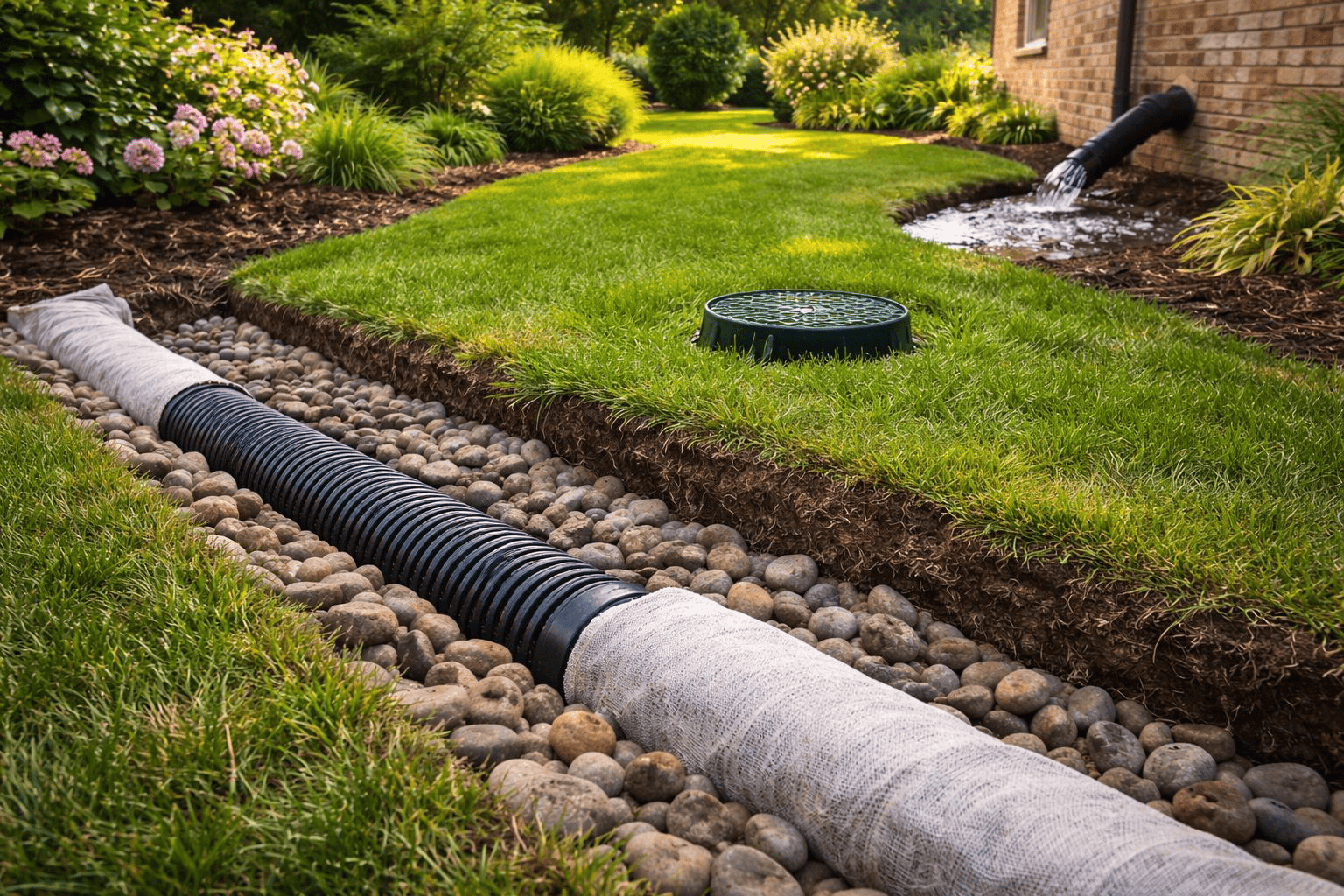
Drainage problems can quickly turn a healthy yard into a muddy, damaged, and difficult-to-use outdoor space. Water pooling after rain, soggy lawn areas, soil erosion, and water flowing toward structures are all signs that water may not be moving properly across your property.
The right yard drainage solutions can help protect your lawn, landscaping, hardscaping, and other outdoor features. However, the best yard drainage solutions depend on why water is collecting and where it needs to go.
At Conlee’s Landscaping, we help homeowners and businesses throughout Northeast Mississippi address drainage and grading issues as part of complete outdoor construction and landscape projects. Our goal is to improve water movement while creating a solution that works with the property’s existing layout and future plans.
What Causes Drainage Problems in a Yard?
Poor grading is one of the most common causes of drainage problems because water naturally follows the slope of the ground. When a yard does not direct water toward an appropriate drainage area, rain can collect in low spots or move toward areas where it can cause damage.
Other potential causes include compacted soil, heavy rainfall, erosion, changes to the landscape, and drainage patterns affected by previous construction.
Common signs include:
- Water pooling after rainfall
- Muddy or consistently soggy areas
- Soil erosion
- Standing water near a foundation
- Damaged grass or plants
- Water flowing toward patios or walkways
- Areas that remain wet long after rainfall
Finding the source of the problem is important. Simply filling a low spot may only redirect the water somewhere else without correcting the underlying drainage issue.
Common Drainage Problems Homeowners Face
Different properties can experience different types of drainage problems depending on the property’s grading, soil, landscaping, and surrounding terrain. Some issues may appear only during heavy rainfall, while others can remain noticeable throughout the year.
Common drainage problems include standing water, muddy lawn areas, soil erosion, water flowing toward the foundation, and areas of the yard that remain saturated after rainfall.
Identifying these issues early can make it easier to determine which yard drainage solutions may be appropriate for the property.
How Yard Grading Can Improve Drainage
Yard grading changes the slope of the ground to help direct water toward an appropriate drainage area instead of allowing it to collect in unwanted locations.
A proper grading plan should consider the entire property rather than focusing on one isolated low spot. The finished grade needs to work with the home’s foundation, landscaping, walkways, patios, retaining walls, and other outdoor features.
Yard grading may be useful when:
- Water collects in low areas.
- Rainwater moves toward your home.
- Soil has shifted or eroded.
- Landscaping has changed existing water flow.
- A new outdoor project requires better drainage.
- The yard remains soggy after rainfall.
Correcting the grade can provide a better foundation for additional yard drainage solutions when they are needed.
Which Yard Drainage Solutions Can Help?
The right yard drainage solutions depend on the property’s layout, soil conditions, elevation, and the amount and direction of water movement.
Some properties may benefit primarily from grading, while others may require additional drainage features. In certain situations, combining several yard drainage solutions may provide a more effective approach.
For example, grading can direct water toward a planned drainage area, while additional drainage measures can help manage water in locations where natural flow is not sufficient.
| Problem | Possible Approach |
|---|---|
| Water collects in low areas | Improve grading and drainage |
| Water flows toward structures | Redirect water flow |
| Soil is washing away | Address grading and erosion |
| Lawn remains consistently soggy | Improve drainage and water movement |
| Drainage affects an outdoor project | Include drainage in the overall design |
A professional assessment can help determine which yard drainage solutions are appropriate for your property instead of installing drainage features that don’t address the actual source of the problem.
Why Water Pooling Should Be Addressed Early
Water pooling may initially look like a minor lawn issue, but repeated standing water can create larger problems for your landscape.
Persistent moisture can make parts of your yard difficult to use and may contribute to soil erosion. Ongoing drainage issues can also interfere with landscaping, hardscaping, retaining walls, patios, and other outdoor improvements.
Addressing drainage early can also make future landscaping projects easier to plan. If you are considering a new patio, retaining wall, sod installation, outdoor living area, or another landscape improvement, water movement should be considered before construction begins.
Solving drainage issues first can help prevent new improvements from being affected by unresolved water flow and may help determine whether additional yard drainage solutions are needed.
Why Landscape Drainage Matters for Outdoor Projects
Proper landscape drainage should be considered as part of the overall design of a property. A beautiful landscape can still experience problems if excess water has nowhere to go.
Drainage planning can be particularly important when adding:
- Patios
- Retaining walls
- Walkways
- Outdoor living areas
- New lawns
- Planting areas
- Hardscaping
- Irrigation systems
When drainage is incorporated into the project from the beginning, the landscape can be designed around the property’s natural water movement. This can also make it easier to incorporate effective yard drainage solutions into a larger outdoor construction plan.
For general information about water-efficient landscaping and responsible landscape planning, homeowners can also review resources from the U.S. Environmental Protection Agency.
When Should You Call a Landscaping Professional?
If your yard continues to experience drainage problems after normal rainfall, professional evaluation may be worthwhile.
A landscaping professional can assess the existing grade, identify where water is coming from, and determine where it should be directed. Professional input is especially valuable when water is causing significant erosion, collecting near structures, or interfering with a larger outdoor construction project.
Conlee’s Landscaping provides drainage and grading solutions for homeowners and businesses throughout Northeast Mississippi. Our team can assess your property and recommend practical yard drainage solutions as part of a broader landscape construction plan.
Our outdoor services also include:
- Retaining walls
- Hardscaping
- Landscape installation
- Irrigation
- Sod installation
- Concrete
- Outdoor living areas
- Outdoor construction
This allows drainage considerations to be incorporated into larger landscape projects instead of being treated as an afterthought.
How to Prevent Future Drainage Problems
Preventing recurring drainage problems starts with understanding how water moves across your property.
Pay attention to your yard during and after heavy rainfall. Areas that repeatedly collect water, develop erosion, or remain wet longer than surrounding areas may need further evaluation.
Practical steps include:
- Watch where water flows during heavy rain.
- Monitor new areas of erosion.
- Don’t ignore consistently soggy areas.
- Consider drainage before major landscape installations.
- Make sure grading works with patios and retaining walls.
- Address drainage issues before beginning major outdoor construction.
- Maintain landscaping and drainage features as recommended.
The goal is to make drainage part of your overall landscape plan rather than waiting until excess water causes visible damage. Planning appropriate yard drainage solutions early can also help protect future landscaping and outdoor improvements.
Why Choose Conlee’s Landscaping?
Conlee’s Landscaping provides landscape and outdoor construction services throughout Northeast Mississippi. Our team works with homeowners and businesses on projects ranging from drainage and grading to hardscaping, retaining walls, sod, irrigation, concrete, and outdoor living spaces.
We understand that drainage can affect much more than the appearance of a lawn. Water movement can influence the condition and usability of other outdoor improvements, which is why drainage should be considered when planning a complete landscape project.
Conlee’s Landscaping also provides written estimates within 48 hours, helping property owners understand the proposed work before moving forward.
Conclusion
Drainage problems should not be ignored when water repeatedly pools in your yard, causes erosion, or moves toward your home and other structures. Simply covering up a wet area may not solve the underlying issue.
The right yard drainage solutions can improve how water moves through the property and help protect landscaping, hardscaping, lawns, and outdoor construction projects. Depending on the property, solutions may include yard grading, drainage improvements, or a combination of approaches.
At Conlee’s Landscaping, we provide drainage and grading solutions throughout Northeast Mississippi and can incorporate effective yard drainage solutions into larger landscape and outdoor construction projects.
If your yard has persistent drainage issues, request a free quote from Conlee’s Landscaping and take the first step toward a healthier, more usable outdoor space.
Frequently Asked Questions
What are the most common signs of drainage problems?
Common signs include water pooling, soggy lawn areas, muddy soil, erosion, standing water, and water flowing toward your home or other structures.
Can yard grading fix drainage problems?
In some situations, yes. Yard grading can change the slope of the ground to redirect water toward a suitable drainage area. However, some properties may require additional yard drainage solutions.
What are the best yard drainage solutions?
There is no single solution for every property. The appropriate yard drainage solutions depend on the property’s grading, soil conditions, water flow, existing structures, and landscape design.
Why is landscape drainage important?
Proper landscape drainage helps manage excess water and can protect lawns, plants, hardscaping, patios, retaining walls, and other outdoor improvements.
How do I stop water pooling in my yard?
Start by identifying why water is collecting in that location. Depending on the cause, improving the grade or adding appropriate yard drainage solutions may help redirect excess water.
When should I hire a professional for drainage problems?
Consider professional help when water continues to pool after rainfall, causes erosion, moves toward structures, or interferes with landscaping or outdoor construction projects. A professional can evaluate the property and recommend suitable yard drainage solutions based on the source of the problem.